Views: 0 Author: Site Editor Publish Time: 2025-11-29 Origin: Site


In modern manufacturing, precision is key to producing high-quality products. Industries like automotive and medical devices demand ever-greater accuracy. One innovation driving this change is the groove centerless grinding machine.
This technology has transformed machining by achieving tight tolerances and enhanced surface finishes. In this article, we'll explore how groove centerless grinding machines are revolutionizing manufacturing efficiency and precision.
Centerless grinding is a method of grinding where the workpiece is not held between two centers as in traditional grinding methods. Instead, it is positioned between a grinding wheel, a regulating wheel, and a work rest support. This setup allows for continuous and efficient grinding without the need for any fixture or chuck.
Unlike traditional cylindrical grinding, where a piece is held between two centers, centerless grinding works by feeding the workpiece through the machine between two wheels: the grinding wheel and the regulating wheel. The grinding wheel removes material from the workpiece, while the regulating wheel controls its speed and direction.
Groove centerless grinding machines are designed to handle components with grooves, flanges, or similar features. These machines are equipped with specialized wheels and setups that enable them to grind precise grooves in workpieces while maintaining dimensional accuracy. The key feature of groove centerless grinding is its ability to process a wide variety of materials, including metals, ceramics, and composites, while achieving consistent surface finishes and tight tolerances.
Groove centerless grinding machines offer several advantages over traditional grinding methods. The most notable benefits include:
● Faster Production Times: By eliminating the need for fixtures and chucks, groove centerless grinding speeds up the machining process, resulting in higher throughput.
● Greater Precision: The machine's ability to maintain consistent surface speeds and tight tolerances ensures superior dimensional accuracy.
● Reduced Operational Costs: With fewer components involved in the grinding process, manufacturers can reduce setup time and labor costs, leading to overall cost savings.
Advantage | Description |
Faster Production | Eliminates the need for fixtures and reduces setup time, speeding up production. |
Greater Precision | Achieves tight tolerances and smooth finishes consistently. |
Reduced Operational Costs | Minimizes labor costs, scrap, and machine downtime. |
Minimal Human Intervention | Automation ensures consistent results with minimal manual involvement. |
Groove centerless grinding machines play a crucial role in improving the accuracy of machined components. By using advanced controls and monitoring systems, these machines can achieve tolerances as tight as a few microns. This level of precision is essential in industries like aerospace and medical devices, where even minor deviations can result in catastrophic failures.
For example, aerospace manufacturers rely on groove centerless grinding to produce turbine blades and other critical components with extremely tight tolerances. Similarly, the medical device industry uses these machines to create orthopedic implants that meet stringent regulatory standards.
One of the key benefits of groove centerless grinding is its ability to produce consistent results across high-volume production runs. The integration of CNC (Computer Numerical Control) technology in these machines ensures that every component is manufactured to the same precise specifications, minimizing the risk of human error and variability in the grinding process.
This consistency is particularly beneficial in industries such as automotive, where manufacturers need to produce large quantities of parts that meet exacting quality standards. Groove centerless grinding machines ensure that each part is identical, improving product reliability and reducing the need for rework.
Groove centerless grinding machines excel at processing parts with complex shapes and tight tolerances. Their flexibility allows manufacturers to grind components with intricate grooves, radii, and other features that would be challenging to achieve with traditional grinding methods. This makes them invaluable in industries that require high-precision components with complex geometries, such as aerospace, automotive, and medical devices.
In the automotive industry, groove centerless grinding machines are used to produce precision components such as transmission shafts, camshafts, and crankshafts. These parts require extremely tight tolerances to ensure proper fit and function within an engine or transmission system. Groove centerless grinding allows for the precise machining of these components while maintaining high throughput.
Case Study: A leading automotive manufacturer faced challenges with processing transmission input shafts. These shafts were prone to bending and deformation, and the company struggled to achieve the required roundness and surface finish. After adopting groove centerless grinding technology, the manufacturer achieved a 99.6% pass rate, significantly improving production quality and efficiency.
In aerospace and defense, precision is paramount. Groove centerless grinding machines are used to manufacture turbine shafts, engine casings, and other critical parts that require high precision and reliability. These machines can handle materials like titanium and high-strength alloys, which are commonly used in aerospace components.
By utilizing groove centerless grinding, manufacturers can ensure that every component meets stringent aerospace standards for dimensional accuracy, surface finish, and structural integrity.
The medical device industry relies on groove centerless grinding machines to manufacture components such as surgical instruments and orthopedic implants. These components must meet strict biocompatibility standards and be manufactured to tight tolerances to ensure they function properly in a medical environment.
Groove centerless grinding enables manufacturers to produce these components with the precision necessary to meet both regulatory requirements and patient safety standards. For example, orthopedic implants require smooth surfaces and accurate dimensions to fit perfectly in the body and function without causing adverse reactions.
In the energy sector, groove centerless grinding machines are used to grind parts like hydraulic cylinders, generator shafts, and other components that require precise machining for performance and reliability. These components are subjected to high stress and must meet strict quality standards to function efficiently in power generation systems.
The versatility of groove centerless grinding makes it an ideal solution for processing parts in the energy sector, where reliability and durability are crucial.
Industry | Application | Benefits |
Automotive | Transmission shafts, camshafts, crankshafts | High precision for engine components |
Aerospace | Turbine blades, engine casings, landing gear parts | Tight tolerances and reliability for critical parts |
Medical Devices | Orthopedic implants, surgical tools | Compliance with biocompatibility and accuracy |
Energy | Hydraulic cylinders, generator shafts | Durability and performance under high stress |
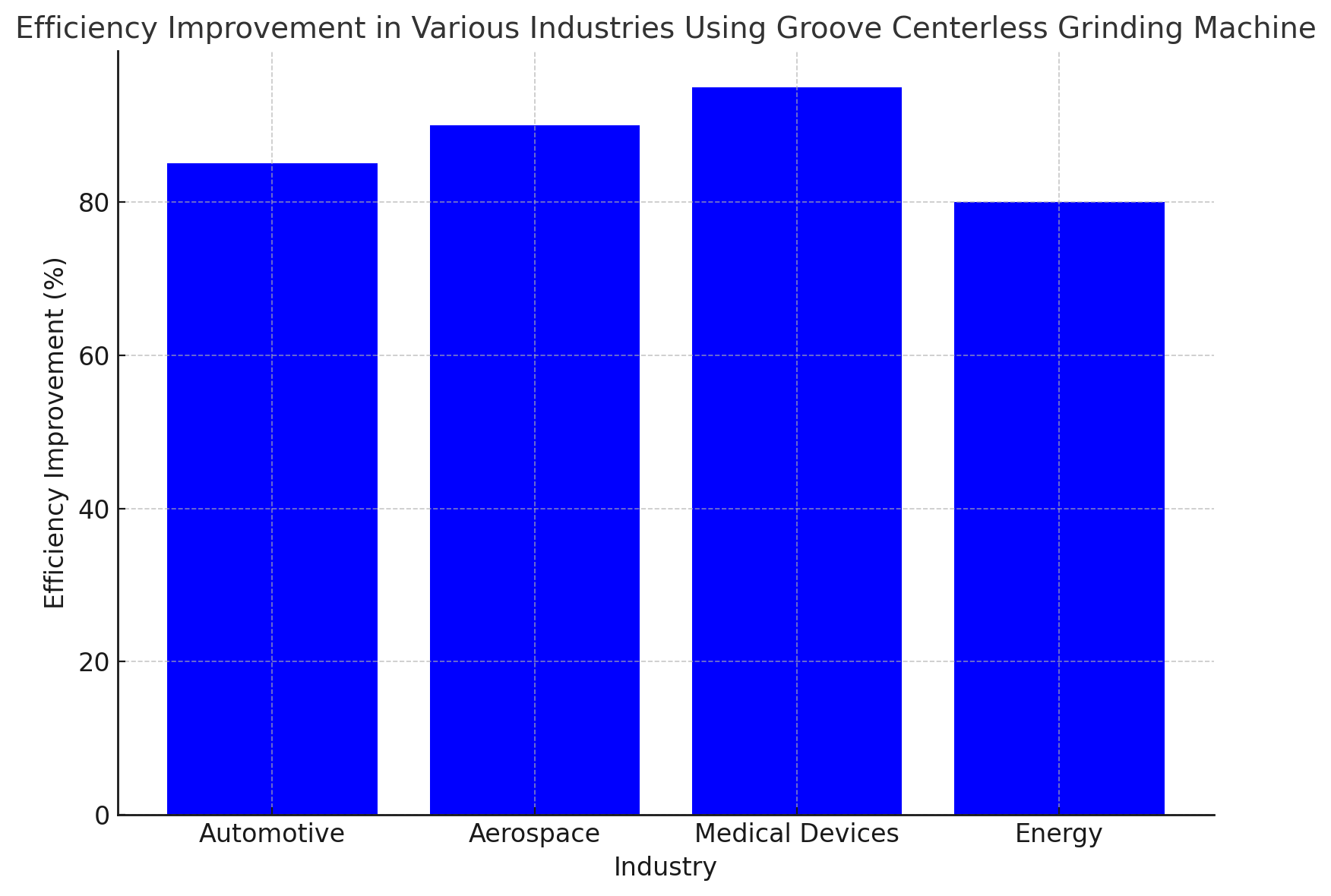
One of the major technological advancements in groove centerless grinding machines is the integration of CNC technology. This allows for precise control over every aspect of the grinding process, from the speed of the wheels to the positioning of the workpiece. Real-time adjustments can be made to maintain optimal grinding conditions, further improving accuracy and efficiency.
Automated loading and unloading systems have also improved the efficiency of these machines, allowing for continuous production without the need for manual intervention.
The integration of IoT (Internet of Things) technology into groove centerless grinding machines enables real-time monitoring of machine performance. Sensors embedded in the machine can track parameters such as vibration, temperature, and wear, providing valuable data that can be used to predict when maintenance is needed. This reduces downtime and helps manufacturers avoid costly repairs.
Predictive maintenance allows manufacturers to keep their machines running smoothly, improving overall production efficiency and reducing the risk of unexpected failures.
In addition to improving precision and efficiency, modern groove centerless grinding machines are also designed with energy efficiency in mind. Advances in motor technology and energy-saving features help reduce power consumption, making these machines more environmentally friendly.
Furthermore, reduced noise levels and lower heat generation contribute to a safer and more sustainable working environment. This makes groove centerless grinding machines a key component of green manufacturing initiatives.
The cost of purchasing a groove centerless grinding machine can be significant, but the long-term savings often outweigh the initial investment. These machines help reduce labor costs, as they automate many aspects of the grinding process. They also minimize material waste and downtime, leading to higher overall efficiency.
For manufacturers, the return on investment (ROI) from groove centerless grinding machines can be substantial. Reduced scrap rates, fewer operator interventions, and faster production cycles all contribute to cost savings over time.
Reliable maintenance and support are essential for maximizing the lifespan and efficiency of groove centerless grinding machines. Regular maintenance helps ensure that the machine operates at peak performance, reducing the risk of unexpected breakdowns and extending the life of critical components.
Manufacturers should work closely with their suppliers to establish a maintenance plan that includes routine checks, repairs, and the replacement of worn-out parts to keep the machine running smoothly.
Maintenance Task | Frequency | Purpose |
Check Grinding Wheels | Weekly/Monthly | Ensure proper condition for optimal grinding performance. |
Check Machine Alignment | Monthly | Maintain precision and prevent wear and tear. |
Replace Worn Parts | As needed | Prevent breakdowns and maintain operational efficiency. |
Lubricate Moving Parts | Monthly | Minimize friction and reduce the risk of machine failure. |
The future of groove centerless grinding machines looks bright, with continued innovations in automation, AI, and machine learning. These technologies will enable machines to make real-time adjustments based on data, further improving precision and efficiency.
As manufacturers continue to seek ways to improve production speed and reduce costs, the integration of advanced technologies like AI and machine learning will play a key role in driving the future of groove centerless grinding.
The demand for high-precision components continues to grow, particularly in industries such as aerospace, automotive, and medical devices. As these industries require increasingly complex and accurate components, the need for advanced grinding technology will only increase.
Groove centerless grinding machines will be at the forefront of this demand, providing manufacturers with the tools they need to stay competitive in an evolving market.
The rise of groove centerless grinding machines marks a significant leap in precision manufacturing. These machines offer faster production, improved accuracy, and reduced costs. Industries like automotive, aerospace, medical devices, and energy are benefiting from these advancements. As technology evolves, groove centerless grinding machines will continue to enhance efficiency and precision.
With the ability to handle complex geometries and tight tolerances, these machines are crucial to shaping the future of precision engineering. Companies like Suzhou Jianuohao International Trade Co., Ltd. provide valuable products that enable manufacturers to achieve higher production quality and efficiency, making these machines an essential investment for modern industries.
A: A Groove Centerless Grinding Machine is a type of precision machinery used to grind components without the need for fixtures or chucks. It is specifically designed to process parts with grooves, ensuring high dimensional accuracy and smooth surface finishes.
A: The Groove Centerless Grinding Machine works by positioning the workpiece between a grinding wheel and a regulating wheel. The grinding wheel removes material while the regulating wheel controls the workpiece's speed and alignment, ensuring precision.
A: Industries like automotive, aerospace, and medical devices benefit greatly from Groove Centerless Grinding Machines. These machines allow for high-precision grinding of complex components with tight tolerances, improving production efficiency.
A: Investing in Groove Centerless Grinding Machines helps manufacturers achieve faster production times, greater accuracy, and reduced operational costs. These machines also improve consistency and handle complex geometries with ease.
A: The Groove Centerless Grinding Machine enhances precision by using advanced controls, reducing human error, and ensuring consistent quality. This results in components with tight tolerances and smooth finishes, crucial for industries requiring high accuracy.
A: Compared to traditional methods, a Groove Centerless Grinding Machine offers faster production, minimal setup, and improved precision. It also reduces operational costs and enhances consistency in mass production.
A: Regular maintenance of a Groove Centerless Grinding Machine includes monitoring the grinding and regulating wheels, checking machine alignment, and replacing worn parts. This ensures optimal performance and prolongs the machine's life.
A: The cost of a Groove Centerless Grinding Machine varies based on features and capabilities. While the initial investment may be high, manufacturers benefit from long-term savings in labor, material waste, and downtime.


